Many sign shops outsource HDU sign production when internal equipment, labor, or space cannot support a project. Outsourcing helps companies offer more design options without adding permanent overhead. It also provides access to manufacturers who understand high-density urethane, finishing, packaging, and installation needs. For many shops, this approach increases capacity while protecting the customer relationship.
HDU sign production has become a practical growth tool across the sign industry and the wider signage industry. Shops can accept larger orders, complex shapes, and detailed finishes without changing their entire manufacturing setup. The right production partner can also reduce waste, missed deadlines, and costly remakes.
What Does It Mean to Outsource HDU Sign Production?
To outsource HDU sign production means sending some or all fabrication work to a wholesale manufacturer. The sign shop still manages sales, design approvals, customer communication, and often installation. Meanwhile, the production partner handles routing, sandblasting, painting, assembly, or shipping.
Some shops outsource the complete manufacturing process. Others request only one stage, such as CNC routing or paint finishing. This flexible model helps companies match each project with the right material, process, and support level.
Which Production Stages Can Be Outsourced?
A wholesale partner may support several parts of the job, depending on the project scope.
| Production stage | Typical outsourced support |
| Material preparation | HDU panels, thickness selection, cutting, and layout |
| Fabrication | Routed details, V-carved lettering, custom shapes, and layered designs |
| Finishing | Primer, paint, semi-gloss coatings, UV protection, and inspection |
| Fulfillment | Packaging, freight preparation, and delivery coordination |
Why Do Sign Shops Outsource HDU Sign Production?
Shops often outsource HDU sign production because specialized fabrication requires time, equipment, and trained labor. A business may own printers and basic cutting tools but lack a CNC router or blasting system. Another shop may have the machinery but no room for added production.
Demand also changes throughout the year. Large monument signs, outdoor signs, or repeat orders can fill a schedule quickly. Outsourcing lets companies expand capacity without hiring staff for a short production increase.
How Does Outsourcing Expand a Sign Shop’s Capabilities?
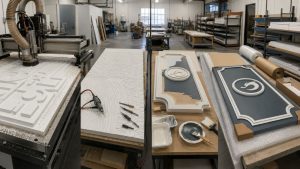
A production partner can help a shop sell products beyond its current equipment limits. These may include sandblasted HDU signs, dimensional logos, hanging signs, and architectural accents. Shops can also request custom shapes, layered elements, or detailed graphics.
This model gives smaller companies access to broader design options. They can offer attractive custom business signs without buying every machine needed to create them. As a result, the shop can compete for more complex HDU sign projects.
How Multiple Sign Companies Can Share One Project
Outsourced fabrication can support projects involving several specialized companies. A January 2026 Signs of the Times feature documented a monument-sign project involving five companies across four states. CARV produced the 2-inch, 15-pound HDU panels, while DBM Signage routed the panels, cut through the blast stencil, and created the woodgrain texture. Other partners handled the sign cabinets, permitting, foundations, masonry, and installation. The project shows how several specialized sign companies can divide production responsibilities to complete work beyond one shop’s internal capabilities.
Products Shops Can Add Without New Equipment
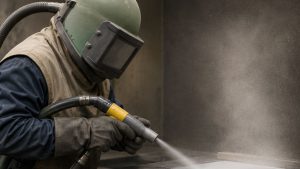
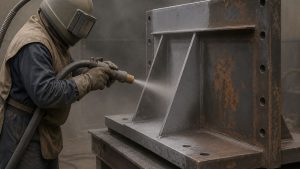
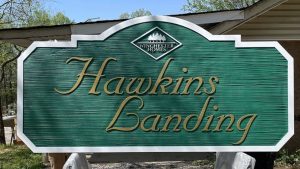
Outsourced manufacturing can cover routed HDU signs and sandblasted signs with textured backgrounds. It may also include HDU panels for monument signs, outdoor signage, and replacement faces. Dimensional logos, carved details, hanging signs, and custom signs can complete the product line.
How Can Outsourcing Reduce Equipment Costs?
Professional HDU sign production may require CNC routers, blasting equipment, dust collection, spray areas, and storage space. Those systems also need maintenance, software, ventilation, utilities, and trained operators. Shops must also manage dust and waste generated during production. The purchase price represents only part of the total cost.
Outsourcing can make sense when HDU orders remain occasional or unpredictable. Instead of investing in equipment that may stand idle, a shop pays for manufacturing when work arrives. However, frequent volume may justify bringing some production in-house.
Why Does HDU Require Specialized Experience?
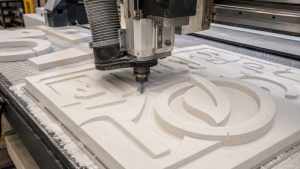
HDU stands for high-density urethane, a durable material with different handling needs than traditional wood. Its closed-cell structure creates a smooth, knot-free surface. That surface supports precise routing, carved details, dimensional elements, and consistent paint coverage.
Experienced manufacturers understand tool speed, routing depth, primer selection, edge finishing, and curing time. These details affect the final image, surface quality, and life of the sign. Small errors can create uneven lines, weak adhesion, or damaged corners.
How Does Outsourcing Help During Busy Periods?
Overflow production gives a sign shop more room when several projects reach manufacturing at once. Seasonal orders, multi-location programs, or urgent customer requests can strain internal teams. Equipment breakdowns and staff absences can also slow the process.
Labor pressure extends well beyond the signage industry. Deloitte and The Manufacturing Institute projected that U.S. manufacturers may need about 3.8 million new employees between 2024 and 2033, with approximately 1.9 million positions potentially remaining unfilled.
Separately, more than 65% of respondents to the National Association of Manufacturers’ first-quarter 2024 outlook survey identified attracting and retaining talent as their main business challenge. These workforce pressures help explain why some sign shops use production partners instead of developing every specialized capability internally.
Can Outsourcing Improve Product Consistency?
Repeatable manufacturing processes can increase consistency across multiple signs. A skilled partner can follow approved measurements, colors, textures, and routing depths. This accuracy matters for franchise programs, replacement panels, and multi-location branding.
Sign quality can affect more than the appearance of a completed project. The Sign Research Foundation reports that sign quality influenced 36% of American consumers to visit a new store. This finding reinforces why sign shops must protect design accuracy, finish quality, and installation readiness when selecting a production partner.
Why Repeat Orders Need Strong Records
Future orders become easier when the manufacturer keeps approved artwork, paint references, and production notes. Accurate records help recreate logos, shapes, textures, and mounting details. They also reduce setup time for the next request.
How Can Outsourcing Reduce Remakes?
Remakes often result from incomplete files, incorrect dimensions, poor finishing, or unclear mounting requirements. An experienced manufacturer reviews specifications before cutting materials. That first review can catch errors before they reach production.
Proofs, color references, and written approvals also reduce risk. Although no process removes every mistake, clear checkpoints increase accuracy. The sign shop can then deliver the project with greater confidence.
Why Do Sign Shops Outsource HDU Sign Production Instead of Wood Signs?
Many shops compare high-density urethane, or HDU, with carved wood or sandblasted wood signs. Wood provides a traditional look, but grain, knots, moisture, and movement can affect the finished surface. HDU offers a uniform structure that supports detailed shapes and consistent results.
HDU also works well for outdoor signage when properly coated and installed. Some people call the material waterproof, but that word can sound too absolute. Proper paint, UV protection, edge coverage, and installation still protect signs from sun exposure for many years.
HDU and Traditional Wood at a Glance
| Factor | HDU | Traditional wood |
| Surface | Smooth, closed-cell, and knot-free | Natural grain with possible knots |
| Design range | Routed, carved, layered, and dimensional | Carved, routed, or sandblasted |
| Maintenance | Depends on finish and environment | May require added moisture care |
| Appearance | Clean or sophisticated look | Natural and traditional character |
How Does Outsourcing Help Teams Focus on Higher-Value Work?
Internal teams create more value when they focus on sales, design, surveys, permits, and installation. Production work can consume many hours, especially when a project needs detailed routing or several paint colors. Outsourcing shifts that workload to a dedicated manufacturer.
This approach also lets staff maintain faster customer communication. Designers can refine graphics, project managers can protect deadlines, and installers can prepare the site. Each person can focus on the work that best supports the business.
Can Outsourcing Protect Project Margins?
Wholesale pricing can make costs easier to estimate before the shop presents a proposal. A clear production quote gives the team a starting point for markup, freight, design time, and installation. It also helps the company compare the outsourced cost with internal labor.
Still, the lowest price does not always offer the best margin. Poor packaging, missed specifications, or weak finishes can generate expensive corrections. Shops should evaluate total project risk, not only the first number on the quote.
When Should a Sign Shop Outsource HDU Sign Production?
Outsourcing may fit when the shop lacks the equipment, skill, space, or time for a specific job. It can also support large orders, complex dimensional work, or products outside the normal service line.
The decision should reflect volume, schedule, freight, quality needs, and internal capacity. A shop should also test the manufacturer before sending a major customer project for the first time.
Common Signs That Outsourcing Makes Sense
A sign shop may benefit when:
- Internal equipment cannot create the requested shape, depth, or finish.
- Current production cannot meet the customer’s deadline.
- The project requires sandblasting, detailed carving, or layered designs.
- Expected volume does not justify a major equipment investment.
- The team needs consistent HDU panels for several locations.
When Does In-House Production Make More Sense?
In-house manufacturing can work well for shops with steady HDU demand, trained staff, and enough space. Direct control may also help when customers request frequent changes. Local work can avoid freight costs and shorten some timelines.
However, ownership brings ongoing expenses. Equipment needs maintenance, operators need training, and materials can generate waste. Each business should compare the total cost before deciding where production should take place.
How Does the Outsourcing Process Work?
Most projects begin with artwork, dimensions, material thickness, quantity, and finish details. The manufacturer reviews the request and asks questions about mounting, colors, or delivery. After that review, the shop receives a price and an estimated schedule.
Production starts after the proof, specifications, and payment terms receive approval. The manufacturer then cuts, routes, textures, primes, paints, assembles, and inspects the sign. Finally, the completed signage is packed for shipment or pickup.
What Information Does a Manufacturer Need?
Complete specifications help the manufacturer generate an accurate quote. Sign shops should provide finished size, thickness, quantity, single-sided or double-sided construction, and delivery location. Production-ready vector artwork also reduces delays.
Other details may include HDU density, custom shapes, paint colors, texture, semi-gloss level, mounting preparation, and required completion date. Reference images can explain the concept, but clean vector graphics usually guide manufacturing.
How Should Shops Choose an HDU Production Partner?
A strong partner should show real experience with HDU signs and wholesale production. Review completed projects, finishing quality, packaging methods, and communication practices. Ask how the company handles proofs, changes, repeat orders, and verified errors.
Good manufacturers also explain what they cannot promise. They should discuss material limits, schedule risks, and shipping factors before production begins. That honesty helps both companies protect the customer.
Questions Worth Asking
Before the first order, request clear information about available thicknesses, densities, textures, and design options. Ask about artwork rules, proofing, timelines, packaging, freight, paint systems, maintenance, and mounting preparation.
What Risks Come With Outsourcing?
Outsourcing creates distance between the shop and the manufacturing floor. Communication delays, freight costs, and shipping damage can affect the final result. Revisions may also take longer after production has begun.
Clear documents reduce those risks. Approved proofs, color numbers, dimensions, deadlines, and mounting notes keep both teams aligned. Reliable packaging and receiving checks also protect the project before installation.
Does Outsourcing Affect the Customer Relationship?
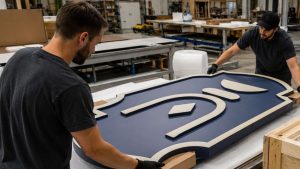
The sign shop should remain the main contact unless another arrangement exists. Customers usually expect the shop to manage design, updates, installation, and service. A production partner works behind the scenes to support that relationship.
Before placing an order, companies should discuss branding, shipping labels, pricing, privacy, and direct communication. These details matter when the shop wants a neutral or white-label process. Written expectations help protect every party.
Why Do Sign Shops Outsource HDU Sign Production for Growth?
Outsourcing gives companies a way to test new products before making a large investment. A shop can add dimensional signage beside its existing banners and printed products without expanding immediately. It can then measure demand before buying equipment.
Growth also depends on reliable capacity. When a trusted manufacturer handles fabrication, the shop can pursue larger accounts and broader signage programs. That support may elevate the company’s offer without increasing fixed overhead too quickly.
Is Outsourcing HDU Sign Production Worth It?
Sign shops often outsource HDU sign production when it increases capacity, protect quality, and support profitable work. The benefits often become stronger when a project needs specialized equipment or detailed finishing. Shops should still compare production price, freight, schedule, and internal resources.
The right choice depends on specific needs. Some companies outsource every HDU project, while others use partners only during busy periods. A balanced model can help shops maintain control while expanding what they sell.
Work With a Wholesale HDU Sign Manufacturer
Why sign shops outsource HDU sign production comes down to capacity, capability, and risk. A qualified manufacturer can create routed, sandblasted, painted, and dimensional work while the shop manages the customer. That division helps teams stay focused and protect their reputation.
CARV supports sign companies that need dependable wholesale HDU sign production. Its team manufactures HDU signs for trade partners using clear specifications and production-focused communication. Request a wholesale quote when your next project requires added capacity or specialized fabrication.
FAQs
Is It Cheaper to Outsource HDU Signs Than to Produce Them In-House?
Outsourcing may cost less when a sign shop does not have the equipment, trained staff, space, or steady order volume needed for HDU production. Compare the wholesale quote and freight costs with internal labor, equipment maintenance, software, material waste, utilities, and production space. In-house production may be more cost-effective for shops with consistent demand and established manufacturing capabilities.
When Should a Sign Shop Outsource HDU Sign Production?
A sign shop should consider outsourcing when a project exceeds its available equipment, experience, space, or production capacity. It can also support large orders, tight deadlines, dimensional signs, sandblasted textures, and detailed routed designs. Some shops use wholesale manufacturers only during busy periods, while others outsource all HDU fabrication.
What Files Does an HDU Sign Manufacturer Need?
CARV requires production-ready vector artwork in AI, EPS, or PDF format. Its quote form also accepts PDF, JPG, PNG, AI, and PSD files as artwork or project references. Raster images can help explain the design concept, but approved vector files should be provided before manufacturing begins.
How Do I Choose a Reliable Wholesale HDU Sign Manufacturer?
Review the manufacturer’s HDU portfolio, proofing process, finishing quality, packaging methods, communication, and experience with repeat orders. Ask how it handles artwork changes, production errors, freight preparation, and schedule delays. CARV publishes a standard three-week production timeline, subject to workload, holidays, and material availability, with production beginning after final-proof approval and payment of the required 50% deposit.